
Start with age
Asbestos cement sheeting was a standard garage roofing material in Britain from the 1930s and was banned outright in 1999. A garage built or reroofed before 2000, especially between the 1950s and 1980s, is the most likely to have it.
If you know the garage was reroofed after 2000, it is very unlikely to contain asbestos.
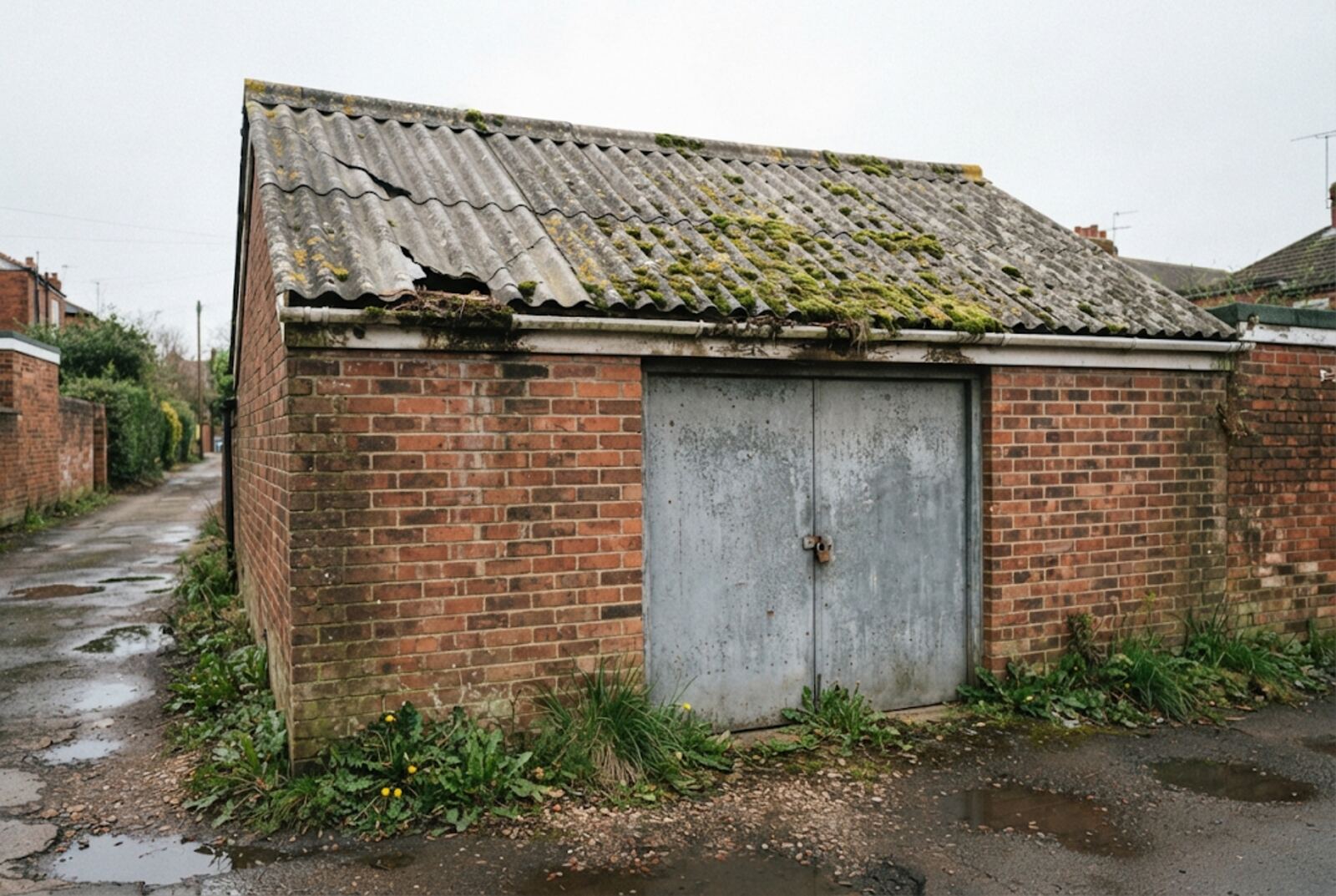
What the roof looks like
Cement sheets are usually grey, dull and slightly rough, with wide corrugations and a thick edge of about 6 mm or more. Over time they grow moss and lichen, go streaky, and may crack or crumble. Metal sheets are shiny or painted, bitumen sheets are black or dark brown and flexible, and fibre-reinforced polyester sheets are translucent.
These clues point a direction but they do not prove anything. Cement-free fibre sheets look almost the same as asbestos cement.
What not to do
Do not scrape, drill, break a piece off, pressure wash or sweep the roof. Do not climb on it either: old cement sheets can be brittle and a fall through is a serious injury. Keep children and pets away from loose pieces on the ground.
The only certain answer
A small sample, taken by a trained person and analysed by a laboratory, is the only way to be sure. Many owners skip it and simply treat any cement sheet roof from before 2000 as asbestos, which is the safe default.
Photos from the ground are often enough for a contractor to give a first opinion, and the quote can then say whether a test is needed.
Quick answers
Is a grey corrugated garage roof always asbestos?
No, but a grey cement-looking sheet from before 2000 is treated as asbestos until proven otherwise.
My roof is mossy. Does that mean it is asbestos?
No. Moss grows on many roof coverings, but on old cement sheets it hides cracks. Do not scrub it off.
Can I tell by tapping the sheet?
No, and tapping risks damage. Use photos and a lab test.
What if I am about to sell the house?
Buyers' surveyors often flag old cement sheets. A test certificate, and ideally a quote for replacement, makes the sale easier.